
After-sales: reducing machine downtime with the right documentation
When a machine stops, the time lost is often the time spent looking for the right procedure, spare part or diagram. Distributing technical documentation on the operator's device, updated and available offline too, shortens intervention times and reduces calls to support.
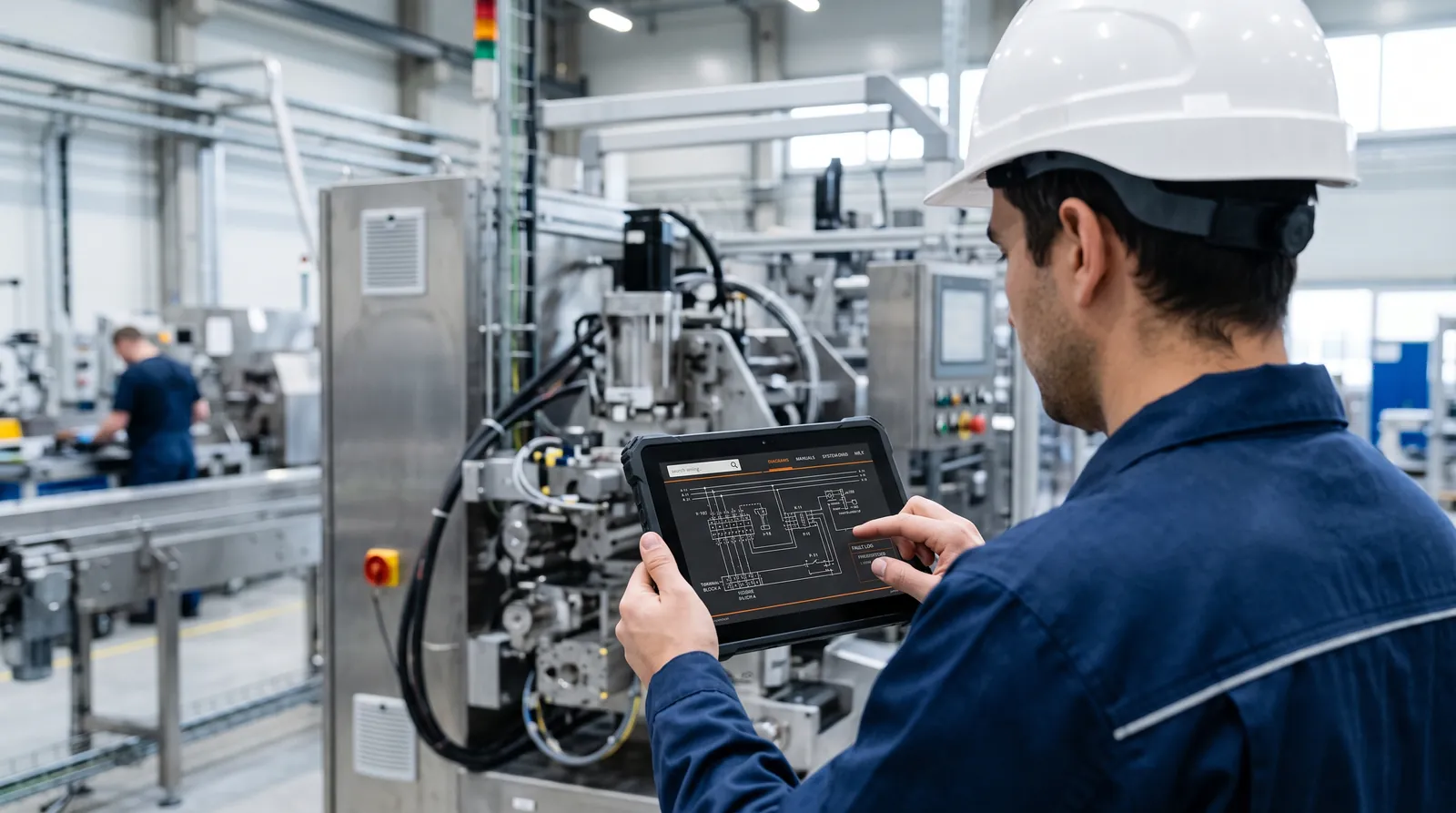
The line stops. From that moment, every minute has a price, and often the bill is not driven by the spare part: it is driven by the time spent looking for the right procedure, diagram and manual. This is why documentation, and how you distribute it, is a concrete lever on service costs.
is the estimated average cost of one hour of unplanned machine downtime in manufacturing. On a global scale, Siemens estimates about 1,3 trillion euros a year lost by the largest companies, 11% of their revenue.
Aberdeen / ServiceMax · Siemens, 2024 · figures converted from USDTime drives the bill, not the spare part
When a technician arrives at the machine, the clock is running. If the manual stayed in the office, the diagram is in an outdated revision and the spare part code is uncertain, the intervention drags on or stalls. Studies on work (IDC, McKinsey) show that people spend hours a day looking for information: in service, those hours become machine downtime. Let's look at where the time of an intervention really goes.
- 1 Arrival
The technician reaches the stopped machine and makes it safe.
- 2 Diagnosis
Understanding what broke and why.
- 3 Searching for the right document
Manual, wiring diagram, spare part code: this is where, with paper, more time is lost than expected.
- 4 Repair
The actual work on the machine.
- 5 Closing
The line restarts. Or, if the right part is missing, you come back with a second visit.
First-time fix: the number that matters
The key after-sales indicator is the first-time fix rate, the share of jobs resolved on the first visit. The industry average is around 77%; it means that, on average, roughly one job in five requires a second visit: more downtime, another trip, a more dissatisfied customer. Up-to-date documentation, in the technician's hands, is one of the factors that make it possible to close on the first visit.
Average first-time fix rate in the industry. The best reach 88-90%; below that threshold, every missed fix comes back as a second visit.
Those who exceed 70% of jobs resolved on the first visit reach a customer retention rate of 86%.
Comparesoft
Digital documentation shortens times and reduces errors
It is not just theory. In documented cases, digital and visual work instructions have cut times and errors sharply: on the Boeing 787, guided wiring instructions lowered assembly time by 25% and errors by 50% (ASSEMBLY Magazine). The manufacturer Airstream reduced new-hire turnover by 83% by switching to digital and visual instructions (Dozuki). These are production settings, but the principle holds identically for service: the right information, clear and at hand, makes work better and faster.
Two ways of working
- Manual in the office or as a printed copy
- Risk of an outdated revision
- Leafing through hundreds of pages
- You need the right copy brought with you
- Spare part code recalled from memory
- Manual and diagram on the device, always with you
- Always the latest revision, from a single point
- Full-text search in a few seconds
- Available offline too, on the shop floor
- Spare parts catalog and ordering from the app
After-sales is profit, not cost
It is worth investing in, because service is where the margin is made. According to Deloitte, after-sales generates on average an operating margin equal to 2,5 times that of new machine sales, and 40-50% of industrial manufacturers' profits come precisely from services. Fast, up-to-date and always-available technical documentation is not an expense: it protects the most profitable part of the business.
What changes with MobileReplica
MobileReplica brings use and maintenance manuals, diagrams, spare parts catalogs and video tutorials directly to the technician's tablet or smartphone, inside the company's branded app. Everything is always at the latest revision, searchable word by word in a few seconds and remains available offline too, in front of the machine. It is the approach with which Breton distributes the technical documentation of its machines worldwide, consultable even without a connection.
Technical documentation on the tablet, at the latest revision and available offline too: the right procedure straight away, without going back to the office.
The part code is identified and ordered from the app: fewer errors on the spare part, fewer second visits.
Step-by-step videos made by the technicians, linked to the right point in the document: the job succeeds on the first try.
The AI assistant searches inside the manuals and answers in plain words, with the source: diagnosis is faster.