
Paper vs digital manuals: what paper really costs
Every printed manual has a cost that does not end with printing: reprints at every revision, shipping, storage and, above all, the risk that someone uses an outdated version. In this article we look at how to estimate the real cost of paper and how much you recover by going digital.
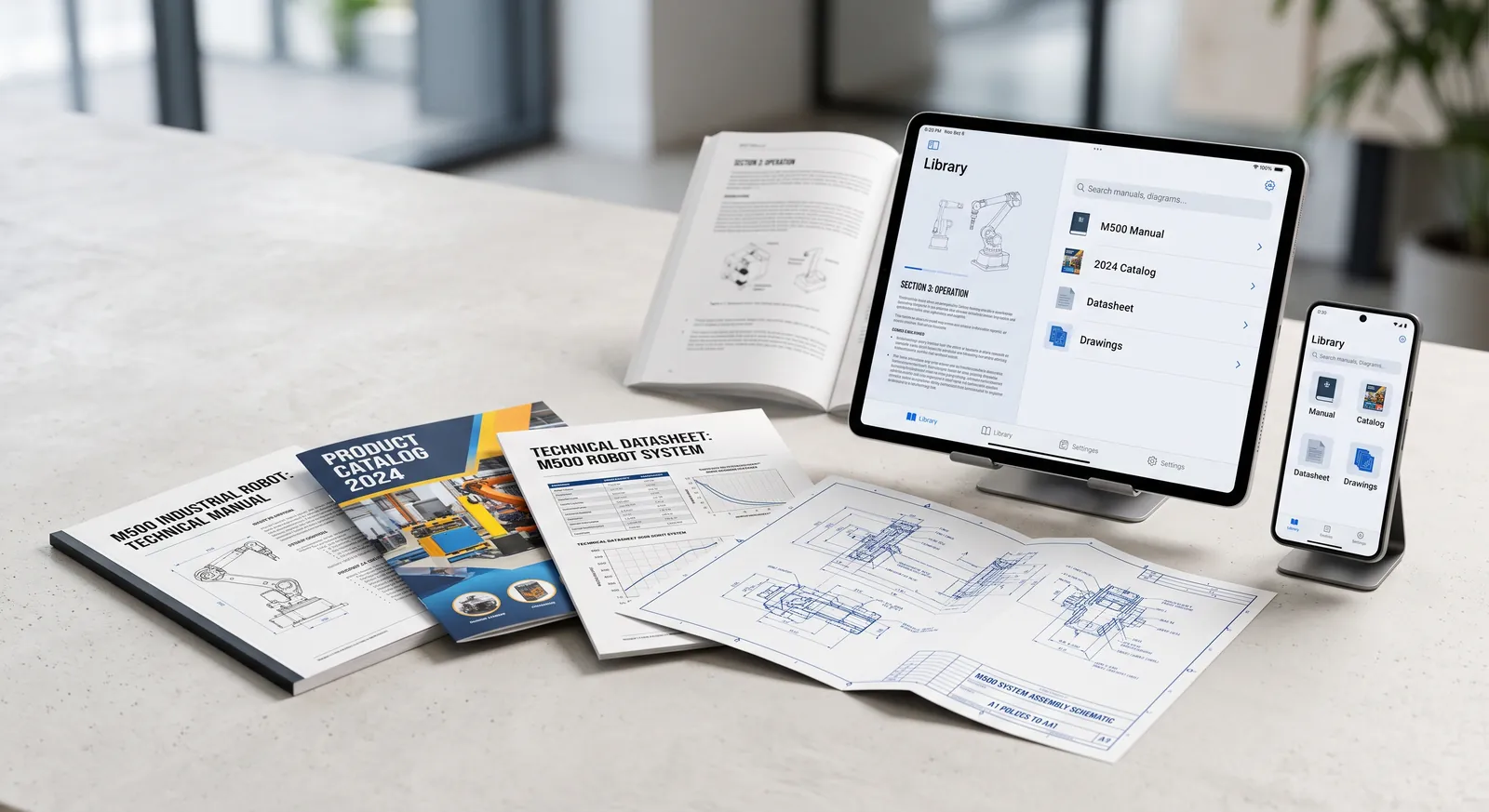
When people talk about the cost of paper, they think of printing and toner. But that is the tip of the iceberg. The biggest expense appears on no invoice: it is people's time, multiplied across every day and the entire organization. Let's put some numbers to it, with the sources.
What does paper really cost?
The direct cost is the one you see: printing and reprinting at every revision, toner, physical storage and the shipping of manuals and catalogs to customers, agents and branches. It repeats at every update, and every copy already distributed has to be replaced. It is a real cost, but it is also the smallest.
Below the surface is the hidden cost: the time lost searching, the wrong versions used by mistake, the documents that have to be redone. What you really pay is here.
- Printing and reprinting
- Toner and materials
- Physical archive
- Shipping
- Time lost searching for documents
- Outdated versions used by mistake
- Documents redone because they cannot be found
- Errors, rework and extra calls
The hidden cost: the time lost searching
A technician looking for a procedure in a binder, an agent chasing the latest price list, an office redoing a document because the original cannot be found: these are minutes that multiply across everyone, every day. It is not a new problem, it has been documented for twenty years, and paper makes it worse, because a physical archive cannot be searched in a few seconds.
A 2021 Elastic study adds a detail that every manager will recognize: 81% of workers struggle to find documents when a customer or a superior is pushing for speed, and 54% say they lose more time on it than on email.
What does using the wrong version cost?
There is an even more insidious cost: using the outdated copy without knowing it. M-Files again finds that 96% of employees have difficulty finding the most recent version of a document. On a catalog this means an old price or a discontinued item; on a manual or a technical datasheet, in regulated sectors like machinery and construction, it can mean a procedure that is no longer valid, a job to be redone, a safety or compliance problem.
- An outdated price or discount presented to the customer
- A maintenance procedure that is no longer valid
- A technical datasheet or certificate in a previous revision
- A distributed document that then has to be recalled and reprinted
And there is the paper that disappears entirely. According to AIIM, 7,5% of paper documents are lost and another 3% filed in the wrong place; recreating a lost document costs on average about 200 euros in labor (value converted from the source's dollars). A cost no one puts on the books, but one that gets paid all the same.
Paper versus branded app: the comparison
The same document, managed on paper or distributed through a branded app, changes nature completely.
| Paper | Branded app | |
|---|---|---|
| Update | Reprint and new shipment | Publish once, it reaches everyone |
| Distribution | Days, with shipping costs | Immediate and free |
| Search | Leafing through by hand | Full-text in a few seconds |
| Version | No guarantee | Always the latest, for everyone |
| Off the network | You need the right copy with you | Available offline too |
| Control | Untraceable copies | Access and usage tracked |
How much do you recover by going digital?
It is not just a saving on paper: it is time that becomes productive again. According to AIIM's Paper Wars report, two thirds of the companies that remove paper from their processes recover the investment within 18 months, and half within a single budget year. The most experienced report customer responses up to 4,6 times faster.
This is exactly what MobileReplica does: manuals, catalogs and price lists are published once and distributed to every device, inside your company's branded app. They are always at the latest version, searchable word by word in a few seconds and available offline too, on the shop floor, on the construction site or at the customer's. Paper stops being a recurring cost.
The document is updated from a single point and reaches everyone: no reprints at every revision, no copies to throw away.
The update is digital and immediate: the cost of shipping manuals and catalogs, which recurred every time, disappears.
Full-text search finds any word in a few seconds: the hours lost searching become productive again.
A single valid copy for everyone, always up to date: the cost of errors from outdated documents disappears.
Frequently asked questions
What is the highest cost item of paper documentation?
Almost always it is not printing, but time: the hours people spend looking for the right document or redoing one that cannot be found. Studies like IDC and McKinsey quantify it in hours per day per person.
Does going digital mean throwing away all the paper?
No, it means eliminating the copies, not the documents. The machinery regulation, for example, from 2027 allows instructions in digital format, with paper available only on request.
How long does it take to recover the investment?
According to AIIM, two thirds of companies recover their paperless investment within 18 months. The return depends above all on how much you spend today on reprints, shipping and lost time.
Do the documents stay available without a connection?
Yes. With MobileReplica the downloaded documents can be consulted offline too, and update themselves at the next connection.